




Security work is mostly unglamorous. It means patching, logging, access reviews, documentation, and long conversations about risk. Television rarely shows that, yet a good cybersecurity series can still teach you something. The best ones don’t show you how to hack. They show how technology reshapes power, trust, privacy, and human behavior, which is the ground security professionals work on every day.
This guide covers seven tech shows that reward viewers who care about security. Some are grounded in real tools and culture. Some are speculative fiction that raises ethical questions years before the real world catches up. One is a comedy that happens to be a sharp portrait of software startups.
A necessary caveat: these are entertainment productions. They compress timelines, simplify technical work, and sometimes invent technology outright. Treat them as a starting point for curiosity, not a curriculum. I’ll flag where each show is realistic and where it isn’t.
Why Tech Series Appeal to Security-Minded Viewers
Technology shows work for different audiences in different ways:
- Cybersecurity professionals enjoy spotting what is accurate, what is exaggerated, and what the writers skipped.
- Developers recognize the culture, pressure, and trade-offs of building software.
- IT enthusiasts like seeing familiar concepts such as networks, authentication, and data flows turned into drama.
- General viewers get an accessible way into topics that normally feel abstract.
Security also suits storytelling because it is built on conflict: attackers and defenders, secrecy and transparency, convenience and safety. Those tensions create strong characters and strong plots.
Quick Comparison Table
| Series | Main Technology Theme | Cybersecurity Relevance | Best For | Watch |
|---|---|---|---|---|
| Mr. Robot | Hacktivism, social engineering, corporate power | Very high; closest to real hacking culture | Security enthusiasts, aspiring analysts | Watch Mr. Robot on Amazon |
| Black Mirror | Speculative tech and its social consequences | Medium; strong on ethics, privacy, and misuse | Privacy enthusiasts, general viewers | Amazon |
| Halt and Catch Fire | Early PCs, online networks, the web | Medium; strong on engineering and computing history | Developers, tech historians | Amazon |
| Silicon Valley | Startups, compression, decentralized internet | Medium; satire of data, platforms, and ethics | Developers, IT professionals | Amazon |
| Person of Interest | AI-driven mass surveillance | High on surveillance and privacy themes | Privacy and AI enthusiasts | Amazon |
| The Capture | Manipulated video evidence and deepfakes | High on digital forensics and trust in evidence | Forensics and OSINT-minded viewers | Amazon |
| Devs | Quantum computing, determinism, secrecy | Low-to-medium directly; strong philosophically | Future-tech and AI thinkers | Amazon |
1. Mr. Robot

What it is about
Mr. Robot follows Elliot Alderson, a young cybersecurity engineer who is also a talented, socially isolated hacker. He is recruited into a hacktivist collective that wants to damage a powerful corporation, and the story becomes a psychological and political thriller about identity, control, and rebellion. It aired for four seasons.
Why cybersecurity fans should watch it
It is probably the most security-literate mainstream drama of its era. The show treats hacking as a human activity driven by curiosity, grievance, ideology, and loneliness, rather than as flashing green text. Security professionals often single it out for the way it takes the culture seriously.
Technology and cybersecurity concepts
- Social engineering: manipulating people into helping an attacker, often by exploiting trust, authority, or urgency. The show gets this right more than most.
- Malware and intrusion: the series depicts compromised systems and persistence at a conceptual level, using tools and ideas drawn from real security practice.
- Insider and corporate risk: an employee with legitimate access is a different kind of threat from an outside attacker.
- Operating-system tooling: you’ll recognize Linux environments and command-line work, which is much closer to reality than typical TV interfaces.
- Hacktivism: the ethical and political debate about using technical skill as protest.
How realistic is it?
- Technical realism: ★★★★☆
- Cybersecurity relevance: ★★★★★
The show’s tools, terminology, and general approach are noticeably more credible than most television. Still, it is a drama. Attacks happen on convenient schedules, targets are unusually permissive, and the work of reconnaissance and failure is trimmed to fit an episode. Real intrusions involve far more dead ends than a character’s single brilliant evening.
What you can learn from it
- People are usually the easiest entry point. The show repeatedly makes the case that technical defenses can be undone by human trust.
- Security is also a mental-health and workplace issue. Isolation, burnout, and obsession are part of the field’s culture.
- Good defense means thinking like an attacker, legally. That idea is the foundation of authorized penetration testing and red teaming.
Best suited for
Cybersecurity enthusiasts, aspiring analysts, IT professionals, and anyone curious about hacking TV shows that respect their subject. Beginners can follow it, though its psychological layers reward patience.
2. Black Mirror

What it is about
Black Mirror is an anthology created by Charlie Brooker. Each episode is a standalone story set in a near-future or alternate world where a technology, often one that looks plausible, produces unsettling consequences. It began on Channel 4 in the UK and later moved to Netflix.
Why cybersecurity fans should watch it
It is less about hacking than about what happens when technology works exactly as designed, and people misuse it, depend on it, or can’t escape it. Themes include data collection, reputation systems, surveillance, coercion, and the loss of privacy. For a security audience it is a useful exercise in threat modeling society.
Technology and cybersecurity concepts
- Data privacy and consent: many episodes explore how personal information gets collected, stored, and used against people.
- Digital surveillance: monitoring that starts as a convenience or safety feature and slides into control.
- Authentication and identity: what counts as proof that you are you, and what happens when that proof is stolen or forced.
- Blackmail and extortion: a few stories echo real cybercrime patterns, where compromised personal data becomes leverage.
- Technology ethics: whether a thing should be built simply because it can be.
How realistic is it?
- Technical realism: ★★☆☆☆
- Cybersecurity relevance: ★★★☆☆
Most of the technology is fictionalized or heavily speculative, and episodes vary widely in tone and plausibility. Its realism lies in human behavior, incentives, and consequences, not in how the devices function. Think of it as a thought-experiment generator.
What you can learn from it
- Technology is shaped by incentives. Companies, governments, and users all push systems in directions designers didn’t plan.
- Misuse is a design input. Asking “how could this be abused?” before release is basic security thinking.
- Social pressure is an attack surface. Reputation and conformity can be exploited as effectively as software flaws.
Best suited for
Privacy enthusiasts, general viewers, and anyone interested in technology ethics. Since each episode tells its own story, you can watch them in any order, making the series a flexible option. Note that many episodes are dark and disturbing.
3. Halt and Catch Fire

What it is about
Halt and Catch Fire follows engineers, programmers, and entrepreneurs through the personal computing industry from the early 1980s into the 1990s, moving from hardware to online communities to the early commercial web. It ran for four seasons.
Why cybersecurity fans should watch it
Security didn’t appear from nowhere. It grew from decades of engineering decisions made under commercial pressure. This show lets you watch that environment form: proprietary systems, compatibility battles, the first online communities, and a young internet where speed beat caution. Understanding why legacy designs look the way they do helps you understand why they are often fragile.
Technology and cybersecurity concepts
- Reverse engineering (conceptual): studying how an existing product works in order to build a compatible one, an idea that sits at the heart of both industry competition and security research.
- Hardware and software interplay: how low-level design choices shape what higher layers can do.
- Early networking and online communities: the social side of connected systems before security norms existed.
- Product pressure versus quality: the trade-off between shipping quickly and building carefully.
- Technology history: how standards and platforms win or lose.
How realistic is it?
- Technical realism: ★★★★☆ for the era’s engineering culture
- Cybersecurity relevance: ★★★☆☆
It is a character drama set inside real industry history, with fictional companies and people. It is not a documentary and shouldn’t be used as one, but it captures the atmosphere and the pressures of building technology in that era very well. Direct security content is limited.
What you can learn from it
- Early design decisions echo for decades. Many modern weaknesses trace back to choices that made sense at the time.
- Technical excellence doesn’t guarantee success. Timing, business models, and relationships matter.
- Innovation is driven by people, shaped by teamwork, personal ambitions, disagreements, and different points of view.
Best suited for
Developers, technology historians, and IT professionals. Beginners can enjoy it as a drama without technical background.
4. Silicon Valley

What it is about
Silicon Valley is a comedy from Mike Judge that follows a small group of founders trying to build a company around a data-compression technology. Over six seasons it satirizes startup culture, venture capital, big-tech egos, and the promises made about the future of the internet.
Why cybersecurity fans should watch it
It is entertaining, but it also gives you an interesting and practical view of how technology companies make decisions and solve problems. Security is rarely the hero in a startup. Growth, funding, and speed usually come first, and the show captures that dynamic. Later storylines touch on data ownership and decentralization, which connect to current privacy debates.
Technology and cybersecurity concepts
- Data compression: reducing the size of data, a real and important field in computing. The show’s version is fictionalized for story purposes.
- Data ownership and platform power: who controls user information, and who profits from it.
- Decentralized architectures: the idea of distributing systems across many devices instead of relying on central servers, with real trade-offs in complexity and security.
- Software engineering culture: code review, technical debt, and the pressure to deliver.
- Product ethics: what founders owe users beyond a polished demo.
How realistic is it?
- Technical realism: ★★★☆☆ (the culture is sharper than the engineering)
- Cybersecurity relevance: ★★☆☆☆ to ★★★☆☆
It is a satire, so exaggeration is the point. Developers often find the startup behavior uncomfortably accurate, but specific technical claims are fictionalized and simplified.
What you can learn from it
- Security is often a business-priority problem, not just a technical one.
- Good ideas can be mismanaged into trouble. Governance and incentives matter.
- Privacy claims need scrutiny. A confident pitch deck proves nothing about actual protections.
Best suited for
Developers, IT professionals, and general viewers who enjoy workplace comedy. Very accessible for beginners.
5. Person of Interest
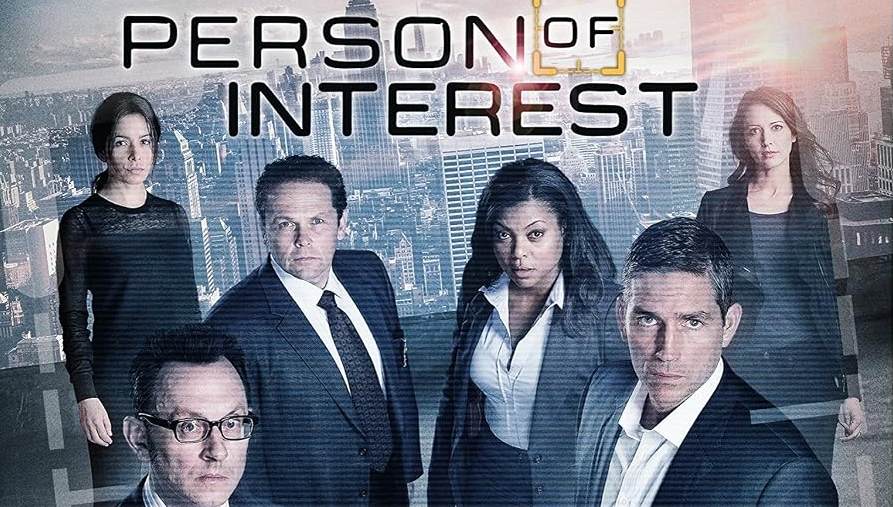
What it is about
Person of Interest begins as a crime procedural and develops into serialized science fiction. A reclusive software genius and a former operative use a powerful, secret artificial-intelligence system, created for government surveillance, to intervene in crimes before they happen. It ran for five seasons.
Why cybersecurity fans should watch it
The show explores surveillance and artificial intelligence with unusual seriousness for network television. It asks hard questions about oversight, secrecy, and who gets to decide what an all-seeing system should do. It premiered in 2011, before public debate over government surveillance reached its later intensity, so it reads today as notably forward-looking.
Technology and cybersecurity concepts
- Mass surveillance and data aggregation: combining many data sources to build a picture of individuals.
- Artificial intelligence and control: a recurring question is whether a powerful AI can be constrained, and by whom.
- Rival AI systems: later seasons explore competing machines with different values, a useful framing for AI safety discussions.
- Social engineering and OSINT-style research: characters gather information about people from public and semi-public sources, which is simplified but conceptually recognizable.
- Access control and oversight: who is allowed to see what, and who watches the watchers.
How realistic is it?
- Technical realism: ★★☆☆☆
- Cybersecurity relevance: ★★★★☆ (for privacy and surveillance themes)
The central AI is fictional and far beyond current capability, and the show’s compressed investigations are dramatized. Its realism is in the ideas: data aggregation, surveillance creep, and the tension between security and liberty are genuinely real issues.
What you can learn from it
- Metadata and aggregated data can be revealing even when no single record is.
- Capability without accountability is dangerous, whatever the intentions behind it.
- AI governance is a security issue, not only a philosophical one.
Best suited for
Privacy enthusiasts, AI-curious viewers, and general audiences. Its procedural beginnings make it easy to enter.
6. The Capture

What it is about
The Capture is a British thriller in which a soldier is accused of a crime based on CCTV footage, and a detective begins to suspect the evidence may not be what it seems. The series explores manipulated video and the power of surveillance to shape what people believe happened.
Why cybersecurity fans should watch it
It focuses on a problem that has become more relevant each year: can we trust digital evidence? Deepfakes and synthetic media have moved from curiosity to real concern, and the series dramatizes what’s at stake for justice, journalism, and public trust.
Technology and cybersecurity concepts
- Deepfakes and synthetic media: AI-generated or altered audio and video that can appear authentic.
- Digital forensics and chain of custody: why evidence needs verifiable provenance, not just a convincing appearance.
- CCTV and public surveillance: the scale of everyday monitoring and the assumptions people make about it.
- Disinformation: how manipulated media can influence public opinion and decisions.
- Institutional trust: what happens when verification lags behind fabrication.
How realistic is it?
- Technical realism: ★★★☆☆
- Cybersecurity relevance: ★★★★☆
Synthetic media is a real and growing field, so the central concern is credible. However, the show’s real-time manipulation of live footage is dramatized and portrays a level of seamlessness that is much more convenient than reality. Treat its technology as an exaggerated version of a real risk.
What you can learn from it
- “Seeing is believing” no longer holds. Verification matters.
- Provenance and authentication of media are becoming essential skills for investigators.
- Surveillance can be wrong, and systems that people trust blindly can produce serious injustices.
Best suited for
Anyone interested in digital forensics, OSINT, journalism, or misinformation. Accessible to beginners.
7. Devs

What it is about
Devs is a limited series from Alex Garland, centered on a secretive technology company, its quantum-computing research, and a young engineer who becomes entangled with its most guarded project. It is more philosophical than procedural.
Why cybersecurity fans should watch it
It is the most abstract entry here, but it raises questions that matter to anyone thinking about the future of computing: secrecy, corporate power, determinism, and what advanced computation might mean for human freedom. It also has a distinctly tense atmosphere around corporate security and insider knowledge.
Technology and cybersecurity concepts
- Quantum computing (fictionalized): the show uses it as a storytelling device with abilities well beyond what real quantum computers can do today.
- Corporate secrecy and compartmentalization: restricting information to small teams, a real security practice that the show treats dramatically.
- Insider risk: what happens when someone inside a trusted environment has different motives.
- Determinism versus free will: a philosophical question about prediction, not a technical one.
- Ethics of powerful technology: who should control capabilities with enormous consequences.
Real-world context (not from the series): quantum computing is relevant to security because sufficiently powerful machines could someday threaten certain widely used public-key cryptography, which is why researchers are developing post-quantum cryptography today.
How realistic is it?
- Technical realism: ★☆☆☆☆
- Cybersecurity relevance: ★★☆☆☆ (direct), though the ideas are thought-provoking
The core technology is speculative fiction and shouldn’t be read as a description of real quantum hardware. Its value lies in mood, ideas, and questions.
What you can learn from it
- Powerful technology tends to concentrate in secretive organizations, which raises accountability questions.
- Insiders are part of any threat model.
- Hype and science can diverge sharply, so critical thinking about emerging technology is a security skill.
Best suited for
Viewers interested in AI, future technology, and philosophy. It is less beginner-friendly in pacing but not technically demanding.
Which Series Is Best for Cybersecurity?
Here is a side-by-side comparison. Scores are my own editorial judgments out of 5, offered as a guide, not measurements.
| Series | Security Realism | Technical Depth | Privacy Themes | Hacking Relevance | Tech Concepts | Social Impact | Beginner Access | Entertainment |
|---|---|---|---|---|---|---|---|---|
| Mr. Robot | 4 | 4 | 4 | 5 | 4 | 4 | 3 | 5 |
| Black Mirror | 2 | 2 | 5 | 2 | 3 | 5 | 5 | 4 |
| Halt and Catch Fire | 3 | 4 | 2 | 1 | 5 | 4 | 4 | 4 |
| Silicon Valley | 3 | 3 | 3 | 1 | 4 | 3 | 5 | 5 |
| Person of Interest | 2 | 2 | 5 | 3 | 4 | 4 | 4 | 4 |
| The Capture | 3 | 3 | 4 | 2 | 4 | 4 | 4 | 4 |
| Devs | 1 | 2 | 3 | 1 | 3 | 3 | 3 | 4 |
The Verdicts
- Best overall: Mr. Robot. It combines the highest security relevance with strong storytelling and the most credible depiction of hacking culture.
- Best for realistic hacking: Mr. Robot. No other title on this list comes close for tools, mindset, and social engineering. Even so, it remains dramatized.
- Best for privacy and surveillance: Person of Interest, with Black Mirror as a close second. Person of Interest examines surveillance as an ongoing system over many seasons, while Black Mirror offers sharper one-off warnings.
- Best for technology and computing history: Halt and Catch Fire. It captures how the personal-computer and early-web industries felt from the inside.
- Best for AI and future technology: Person of Interest. Its serialized treatment of AI control and competing systems gives it more depth than the others. Devs is the pick if you prefer philosophy over plot.
- Best for beginners: Silicon Valley, with Black Mirror close behind. Both require no technical background and deliver ideas through humor or self-contained stories.
If You Like This, Watch That
Use this map to move between shows based on what you enjoyed.
- If you liked Mr. Robot → try The Capture for a more procedural look at digital evidence, or Person of Interest for surveillance and social engineering themes.
- If you liked Black Mirror → try Devs for a slower, more philosophical take on technology, or The Capture for a grounded cousin of its media-manipulation stories.
- If you are interested in AI → start with Person of Interest, then Devs and individual Black Mirror episodes.
- If you are interested in surveillance → Person of Interest, The Capture, and the privacy-focused Black Mirror episodes.
- If you are interested in computer history → Halt and Catch Fire, then Silicon Valley for the modern-day satirical counterpart.
- If you are interested in hacking → Mr. Robot is the clear starting point. For the culture around building and breaking technology, add Halt and Catch Fire.
Prefer to go beyond fiction? Pair your viewing with reading on cybersecurity fundamentals, network security, ethical hacking, malware analysis, and OSINT, topics that appear throughout this site.
10 Cybersecurity Lessons You Can Take From Tech Series
None of these require a keyboard. They are ideas that recur across the shows.
- Humans are often the weakest security layer. Persuasion, pressure, and trust are repeatedly more effective than technical force. Training and culture matter as much as tools.
- Privacy has technical and social dimensions. Encryption helps, but so do laws, norms, and what people agree to share.
- Convenience can introduce risk. Every shortcut, default setting, and “remember me” feature is a trade-off worth examining.
- Technology can be abused even when designed for legitimate purposes. Good intentions don’t prevent misuse, so plan for it.
- Security requires understanding systems and people. Attackers study both. Defenders should too.
- Insiders matter. Anyone with legitimate access is part of the threat model, including trusted staff.
- Aggregated data is powerful. Small, harmless-looking records can reveal a lot when combined.
- Digital evidence needs verification. In a world of synthetic media, provenance and authentication are essential.
- Speed and security are often in tension. Shipping fast is rewarded, but cutting corners creates debt that someone eventually pays.
- Oversight and accountability are security controls. Powerful systems, from corporate platforms to AI, need checks on how they are used.
Conclusion: Fiction as a Doorway, Not a Destination
Technology series aren’t training manuals, and they shouldn’t be treated as one. They simplify, dramatize, and sometimes invent. But that’s not a reason to dismiss them. At their best they do something a textbook can’t: they make you care about how technology shapes lives, institutions, and trust.
A good cybersecurity series can spark a question. How does social engineering actually work? What makes a system tamper-evident? How do you tell a real video from a manipulated one? The answers belong in legitimate resources: official documentation, reputable courses, security conferences, and controlled lab environments where you practice only on systems you own or have explicit permission to test.
So use these seven shows as a starting point. Enjoy the story, notice where reality and fiction diverge, then follow your curiosity somewhere responsible.
Also, learn
- Network Security Tools Explained: Nmap, Nessus, OpenVAS and Wireshark
- Complete Nmap Guide: Network Scanning, Service Enumeration, NSE, Output Analysis, and Security Auditing and
- Best Hacking Operating Systems: Kali, Parrot, BlackArch, Tails & CAINE
Frequently Ask Question
1. What is the best cybersecurity series to watch?
Mr. Robot is widely considered the strongest choice for cybersecurity relevance because of its focus on hacking culture, social engineering, and corporate security. For privacy and surveillance, Person of Interest is a better fit.
2. Are hacking TV shows realistic?
Some are more credible than others. Mr. Robot is known for drawing on real tools and ideas, but it still compresses timelines and simplifies complex work. Most hacking shows dramatize attacks for pacing, so treat them as entertainment.
3. Can I learn cybersecurity by watching these series?
Not on their own. They can introduce concepts and build interest, but real skills come from structured courses, documentation, and hands-on practice in legal lab environments.
4. Which series is best for beginners?
Silicon Valley and Black Mirror are the most accessible. Neither requires technical background, and both present ideas in an engaging, easy-to-follow way.
5. Which show best explores privacy and surveillance?
Person of Interest examines surveillance and AI over many seasons, while Black Mirror and The Capture tackle privacy and digital evidence through shorter stories.
6. Is the technology in these shows real?
It varies. Much of the hacking culture in Mr. Robot and the industry history in Halt and Catch Fire is rooted in reality, while the AI in Person of Interest and the quantum technology in Devs are fictionalized.
7. Do these series show how to hack real systems?
No, and they shouldn’t be used that way. They present hacking at a story level. Attempting unauthorized access to real systems is illegal and harmful.
Affiliate Disclosure: Some links in this article are Amazon affiliate links. If you purchase through these links, I may earn a commission at no additional cost to you.