



Starting a cybersecurity career can feel like paying admission before you’ve seen the show. Exams cost money, bootcamps cost more, and every guide points somewhere different. The good news is that several respected vendors and platforms let you learn the fundamentals at no charge.
The catch is in the word “certifications.” Search for free cybersecurity certifications for beginners and you’ll find lists that blur free courses, digital badges, completion certificates and paid proctored exams. Some lists are also out of date. ISC2 closed its free Certified in Cybersecurity offer to new enrollments on May 20, 2026, yet many roundups still call it free.
This guide compares eleven resources and separates what is genuinely free from what costs extra. Free training builds knowledge. It does not guarantee a certificate, an interview or a job, and I’ll say so plainly throughout.
Quick comparison of the eleven resources
| # | Provider | Resource type | Free learning? | Free certificate or badge? | Possible exam cost | Beginner fit | Official link |
|---|---|---|---|---|---|---|---|
| 1 | Cisco Networking Academy | Free course + optional paid exam | Yes | Badge on passing the final exam | CCST Cybersecurity US$125 | High | Course |
| 2 | Fortinet Training Institute (NSE 1-3) | Training + vendor certifications | Yes (labs cost extra) | Badges; NSE 1-3 certifications | NSE 4-6 US$200; NSE 7 US$200, rising to US$400 on Nov 2, 2026 | High for NSE 1-2 | Free training |
| 3 | IBM SkillsBuild | Free course | Yes | Credly badge at 80% on the final assessment | None | Medium to high | Badge page |
| 4 | AttackIQ Academy | Free courses (purple teaming, MITRE ATT&CK) | Yes, per AttackIQ | Not verified | None listed | Medium | Academy |
| 5 | Centri Blue Team Junior Analyst | Free six-course pathway | Yes | Certificate of completion | None listed | High | Pathway |
| 6 | Qualys | Product training + product certification | Yes | Course certification; format not verified | None listed | Medium (tool-specific) | Training center |
| 7 | OPSWAT ICIP | Short intro course | Price not verified (see below) | Completion certificate | None | Medium | Course |
| 8 | ISC2 CC | Professional certification | No (free program closed May 20, 2026) | No | US$199 exam + US$50/yr fee | High, no experience required | CC page |
| 9 | Microsoft Learn | Learning paths + separate exam | Yes | Achievement trophies only | SC-900 price varies by country | Medium to high | Learning path |
| 10 | Palo Alto Networks | Free courses + paid certification | Yes | Not verified | Paid; fee not verified | High | Learner courses |
| 11 | TryHackMe | Hands-on practice platform | Partly | Path certificate needs Premium | SEC0 EUR 59 | High | Pre Security |
A certification means you passed an exam. A badge or certificate of completion means you finished a course. All amounts are as published on October 11, 2026.
Free Cybersecurity Certifications for Beginners
1. Cisco Networking Academy: Introduction to Cybersecurity

Cisco’s Introduction to Cybersecurity is a free, self-paced course aimed at people with no background. Cisco’s badge description says the course covers the global impact of cyber threats, vulnerabilities, threat detection and defense, and the career paths that follow.
- Cost: the course is free. You earn a digital badge by passing the final exam. Third-party sites also report a completion certificate, but I could only confirm the badge from Cisco’s own pages. Course length is quoted from about 6 to 15 hours depending on the source, so check the course page.
- The paid next step: If you want to pursue a higher-level Cisco credential, you can consider the CCST Cybersecurity certification. The exam fee is $125, and you’ll have 50 minutes to complete it. Cisco says its Junior Cybersecurity Analyst career path prepares learners for it.
- Best for: absolute beginners who want a gentle, conceptual start. Limits: it’s introductory and mostly concepts, not hands-on skill.
- Get started: create a free Networking Academy account, enroll, and pass the final exam to claim the badge.
2. Fortinet Training Institute: NSE 1, 2 and 3

Fortinet gives away its training. Fortinet states that all self-paced courses are free, while hands-on labs are paid add-ons.
What changed in 2026: on July 15, Fortinet restructured its NSE program from five levels to eight. The updated beginner courses are NSE 1 “Cybersecurity and Cloud Fundamentals,” NSE 2 “Introduction to Next Generation Firewall,” and NSE 3 “FortiGate Operator.” Older course names were retired, so any article using them is stale.
Cost breakdown:
- Training: free.
- NSE 1-3: course-based, with online exams for NSE 1 and NSE 3. I found no fee listed on the pages I read. Confirm in the portal.
- NSE 4-6: proctored exams at US$200. According to Fortinet’s help desk, NSE 7 and industry certification exams currently cost $200. The fee is scheduled to increase to $400 starting November 2, 2026. The program page mentions a different date, so check before relying on it.
- Certifications last two years.
Format and limits: video lessons and quizzes, with practical labs only if you pay. Beyond NSE 1, the content centers on Fortinet products, which helps if your target employers use them.
Get started: create a free account, take NSE 1, then NSE 2 and 3.
3. IBM SkillsBuild: Cybersecurity Fundamentals

IBM’s Cybersecurity Fundamentals course is free through IBM SkillsBuild. IBM’s badge page says it covers threat groups, attack types, social engineering, cryptography, and how organizations prevent, detect and respond to attacks. It also touches on the job market.
- Cost: free. To earn the badge you register as an IBM SkillsBuild user, complete the course, and score 80% or higher on the end-of-course assessment. Enrollment options vary depending on who you are. Adults aged 18 and older have a separate registration link, while high school students and educators need to use their designated links. Credly lists the level as intermediate, yet it has no stated prerequisites; treat it as a first or second course.
- Duration: Credly says only “hours.” IBM’s own blog groups it among courses that take about 10 hours in total, but I did not confirm the single-course length.
- Best for: learners who want a free, structured overview with a verifiable badge. Limits: it is a badge, not a proctored certification, and it is conceptual.
- Get started: register on IBM SkillsBuild, find Cybersecurity Fundamentals in the catalog, and aim for 80% on the final assessment.
4. AttackIQ Academy
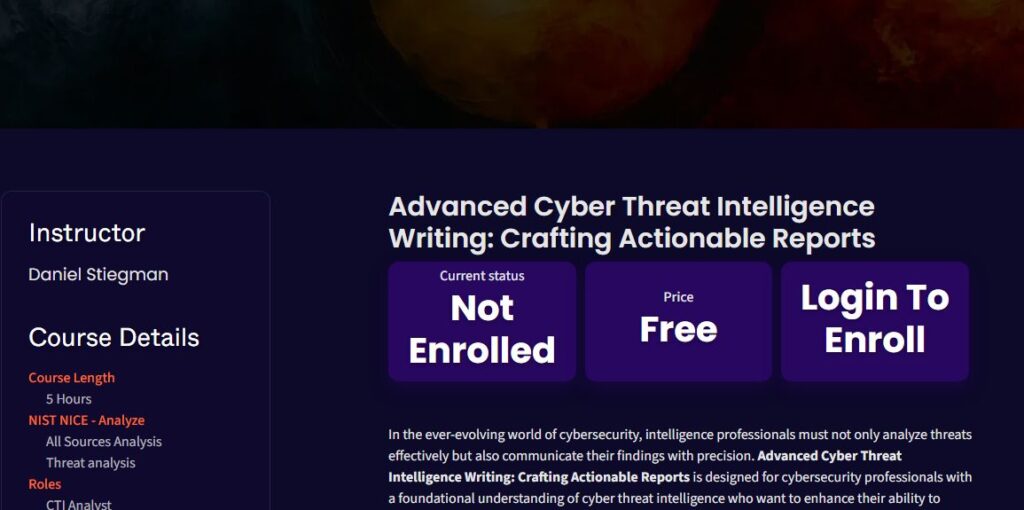
AttackIQ makes breach and attack simulation software. Its glossary page describes AttackIQ Academy as offering free instructor-led courses in purple team operations, MITRE ATT&CK and attack simulation, with guest lecturers and eligibility for (ISC)² CPE credits.
- Cost: free, according to AttackIQ. Certificate or badge: not mentioned on that page, and the Academy site itself did not load for me without JavaScript, so I could not confirm any credential, course list or prerequisites.
- Best for: learners who already know basic security vocabulary and want to see how defenders test their controls against known attacker techniques. Limits: it is more specialized than the others, and I found no beginner-level label.
- Get started: open the Academy, create an account, and check each course page for its credential before you count on one.
5. Centri Blue Team Junior Analyst Pathway
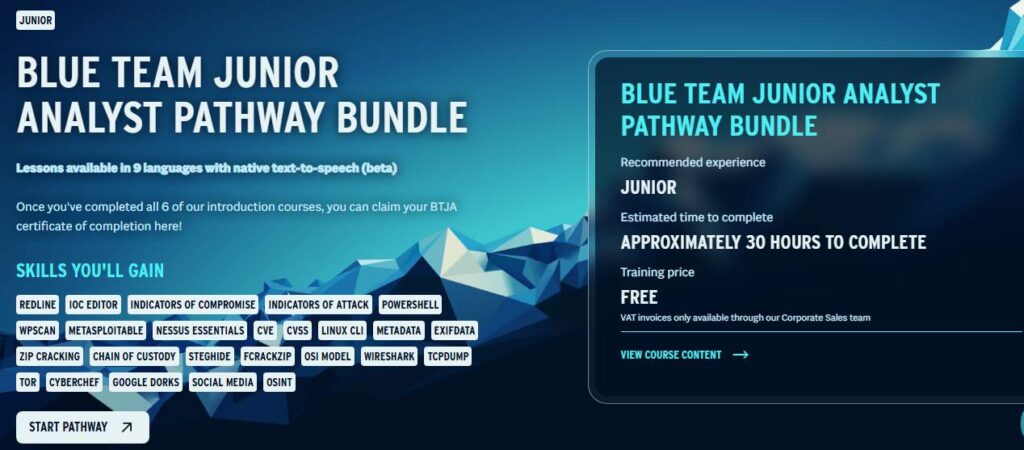
Centri’s Blue Team Junior Analyst (BTJA) pathway is a free defensive-security course bundle. The older securityblue.team address redirects to Centri’s site. On its pathway page, the training price is listed as free.
- What you’ll study: six introductory courses covering OSINT, digital forensics, dark web operations, threat hunting, vulnerability management and network analysis. Tools mentioned include Wireshark, TCPDump, CyberChef and Nessus Essentials.
- Duration: the listing estimates about 30 hours, while the FAQ says completion typically takes 6 to 7 hours. Plan for the longer figure if you’re new.
- Credential: finishing all six courses lets you claim a BTJA certificate of completion. No exam is mentioned. Prerequisites: none.
- Best for: beginners who want a defensive, SOC-flavored starting point.
- Limits: A course completion certificate may not carry as much professional value as a certification earned by passing a supervised exam.
Get started: create a Centri account, work through the six courses in order, then claim the certificate.
6. Qualys: free vulnerability-management training

Qualys makes vulnerability scanning software. Its Certification and Training Center offers free self-paced and instructor-led courses on its own platform, organized into learning paths for vulnerability management, policy compliance, PCI compliance and endpoint detection.
- What you’ll study: start with the optional Vulnerability Management Foundations, then the VMDR course, scanning strategies and reporting.
- Cost: the center says training is free, and I found no exam fee. You create a training account, and the course pages say labs are built in. Qualys says a trial account isn’t required. I wasn’t able to verify whether there are any additional eligibility requirements beyond creating an account.
- Strengths: practical exposure to how organizations find and prioritize vulnerabilities.
- Limits: it teaches one product and is a niche credential.
Get started: To begin, sign up for an account and take the Vulnerability Management Foundations course. If you find it useful, you can move on to the VMDR training to learn more.
7. OPSWAT Introduction to Critical Infrastructure Protection (ICIP)
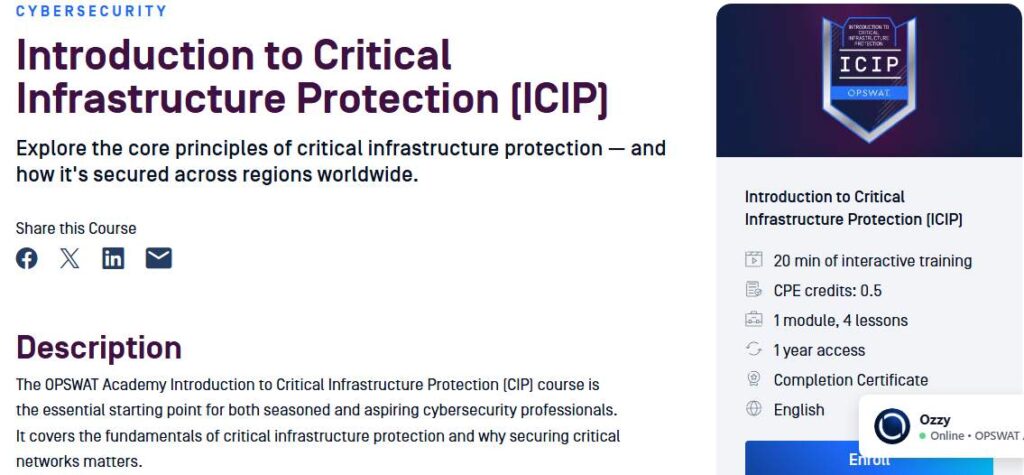
OPSWAT’s ICIP is the shortest course in this list. According to OPSWAT Academy’s course page, it is 20 minutes of interactive training in one module with four lessons: an introduction, CIP fundamentals, CIP sectors, and cybersecurity in critical infrastructure. After completing the program, you receive a certificate of completion, earn 0.5 CPE credits, and get a certificate that remains valid for one year.
- Cost: this is where sources disagree. According to the information on Credly, this digital badge is available at no cost and can be earned by successfully completing the final assessment. OPSWAT’s course page shows an Enroll button with no standalone price, and the Academy home page says “Start for Free” without naming which courses are free. Confirm at checkout that ICIP is still free. The Academy also sells other courses, so don’t assume free access beyond this one.
- Prerequisites: none listed. Passing it also unlocks OPSWAT’s OFSA and OECA programs, per the badge page.
- Best for: If you want to learn how operational technology (OT) works and how essential infrastructure is protected from cyber threats, this course is a useful place to begin.
- Limits: twenty minutes is an introduction, not a skill set. This credential is issued by the company that provides the training, rather than being an independent, industry-wide professional certification.
Get started: create an OPSWAT Academy account, enroll in ICIP, and pass the final exam.
8. ISC2 Certified in Cybersecurity (CC): a real certification, no longer free
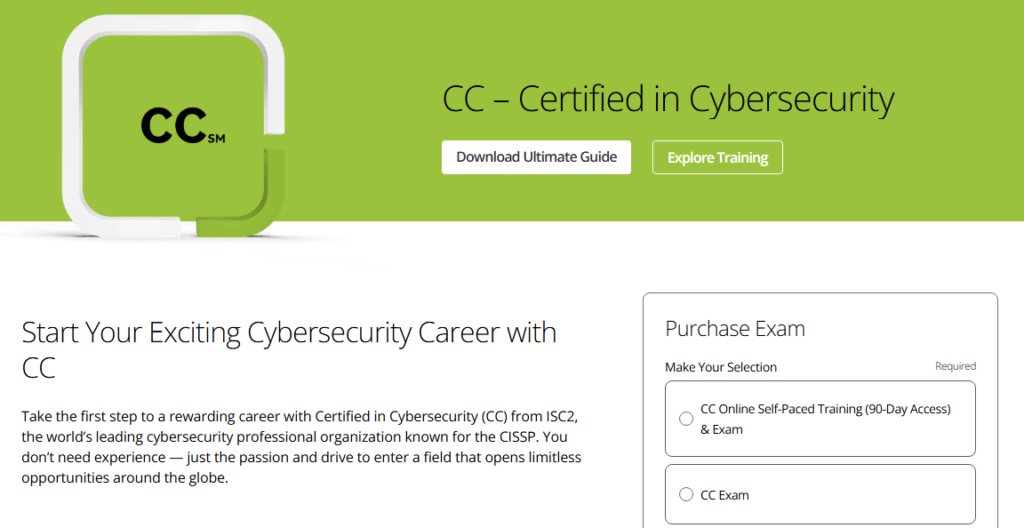
ISC2 is the organization behind the CISSP, and CC is its entry-level credential. ISC2 says it requires no work experience, is accredited under ISO/IEC 17024, and is approved under the U.S. Department of Defense’s Manual 8140.03.
- What you’ll study: foundational concepts a junior security professional needs. ISC2 published an article about an updated CC exam in August 2026, so download the current exam outline instead of trusting older study guides.
- Cost: this is where older articles go wrong. ISC2 states that its free-training-and-exam program closed to new enrollments on May 20, 2026. People who already hold an unexpired exam code can still sit the exam by December 31, 2026. Everyone else pays US$199 for the exam, plus a US$50 annual maintenance fee after passing. Official training is sold separately.
- Prerequisites: none. Format: online training you choose to buy, then a proctored exam scheduled through Pearson VUE.
- Strengths: a recognized, proctored credential from a respected body. Limits: no longer free, and knowledge-based rather than hands-on.
Get started: read the CC page and exam outline, study with the free resources above, and buy the exam only when you can pass in one sitting.
9. Microsoft Learn: free security paths, separate exam

Microsoft Learn is a learning platform, not a certification. Its training connects to the SC-900 Security, Compliance, and Identity Fundamentals exam, which is separate and paid.
- What you’ll study: the Introduction to security, compliance, and identity concepts path has two modules covering shared responsibility, Zero Trust, encryption, data residency, authentication, and identity providers. It’s the first of four SC-900 paths. Microsoft also lists a primer, Describe the concepts of cybersecurity.
- Prerequisites: none.
- Cost: I saw no purchase requirement on the learning paths. The SC-900 exam is 45 minutes and proctored, and its price depends on your country. Microsoft notes the English exam updates on October 21, 2026.
- Strengths: polished, free, structured.
- Limits: Microsoft-centric, and Microsoft expects some familiarity with Azure and Microsoft 365.
Get started: sign in with a Microsoft account, begin with the primer, then the SC-900 paths, and try the practice assessment before paying for the exam.
10. Palo Alto Networks Cybersecurity Academy
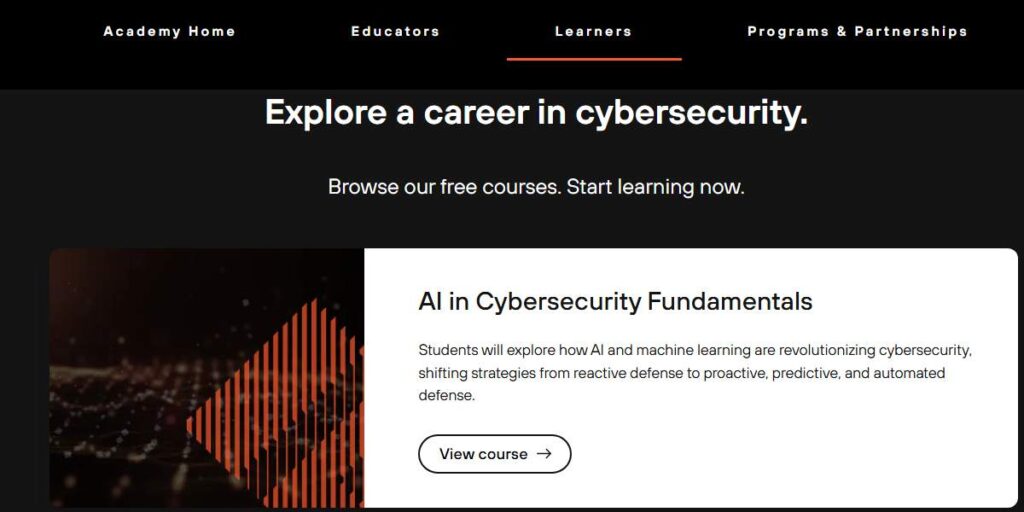
Palo Alto’s Cybersecurity Academy is built for schools: institutions apply to teach its curriculum. Individuals, though, can use the free online courses on its learner page: AI in Cybersecurity Fundamentals, Cybersecurity Fundamentals, Network Security Fundamentals, Cloud Security Fundamentals, and Security Operations Fundamentals.
- Cost: the courses are free. Whether you receive a certificate or badge on completion, I could not verify, because the course portal didn’t load without JavaScript. The paid option is the Palo Alto Networks Certified Cybersecurity Practitioner credential. Credly indicates that it requires payment, but I couldn’t find an official source confirming the exact exam fee.
- Best for: a structured, vendor-written tour of network, cloud and security-operations basics.
- Limits: it leans toward Palo Alto’s product view, and labs are advertised for academy members.
Get started: pick Cybersecurity Fundamentals, add Security Operations Fundamentals if SOC work appeals, and confirm any credential terms in the portal.
11. TryHackMe: hands-on practice with paid upgrades
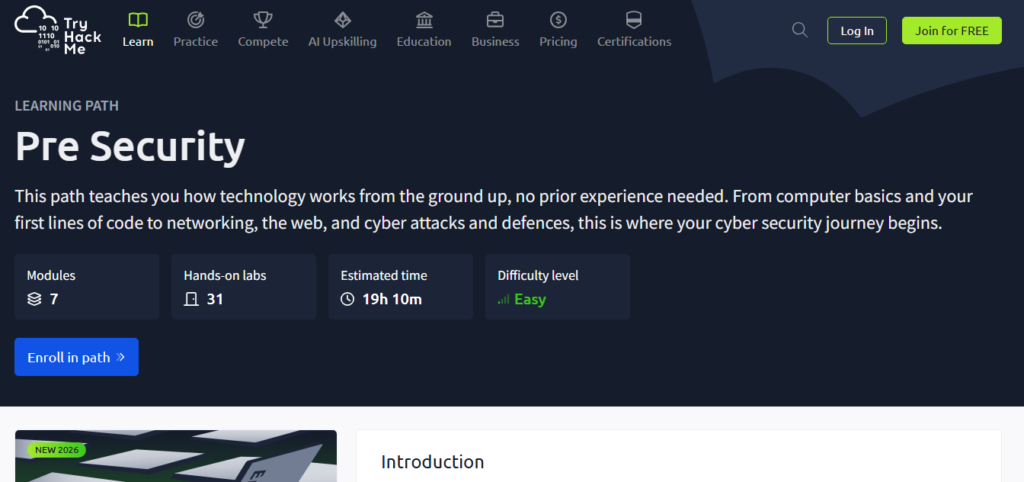
TryHackMe isn’t a certification body. It’s a browser-based practice platform, which makes it the best fit here for learning by doing.
- What you’ll study: the Pre Security path is rated easy, with 7 modules and 31 hands-on labs, estimated at about 19 hours. It covers how computers work, operating systems, basic coding, networking, how the web works, and attacks and defenses. No prior experience is needed.
- Cost, honestly: per the pricing page, the free plan gives limited access to learning paths and free rooms, with one hour of browser-based attack machine time per day. Full beginner-path access and a certificate of completion for each path need Premium, listed at EUR 16.99 a month (lower on annual billing; promotions vary). Its SEC0 certification costs EUR 59 with a 24-hour exam window and one free retake. SEC0 is TryHackMe’s own credential, not an industry standard.
Get started: create a free account, work through the free introductory rooms, and upgrade only if you finish them and want the rest.
Which resource should beginners choose?
No provider is best for everyone. Match the resource to your goal.
| Your goal | Start here | Why |
|---|---|---|
| No IT experience | Cisco Introduction to Cybersecurity, plus TryHackMe free rooms | Gentle concepts plus hands-on basics |
| A free badge or certificate fast | IBM Cybersecurity Fundamentals, Centri BTJA, or OPSWAT ICIP | Free credentials of completion (confirm OPSWAT’s price) |
| Security operations (SOC) | Centri BTJA, Palo Alto Security Operations Fundamentals | Defensive, analyst-style work |
| Networking and firewalls | Fortinet NSE 1 to 3 | Firewall and network security focus |
| Cloud security | Microsoft Learn SC-900 paths, plus Palo Alto Cloud Security Fundamentals | Azure and Microsoft 365 context, plus cloud basics |
| Vulnerability management | Qualys learning path | Direct scanner-based practice |
| Threat testing and purple teaming | AttackIQ Academy | Attack simulation and MITRE ATT&CK (after the basics) |
| Industrial and critical infrastructure | OPSWAT ICIP | Quick intro to CIP sectors |
| Practical labs | TryHackMe Pre Security | Browser-based, guided practice |
| A recognized professional certification | ISC2 CC (US$199), Cisco CCST (US$125), or Microsoft SC-900 | Proctored exams, and all cost money |
Are free cybersecurity certifications really free?
Often the learning is free and the credential is not. Know the difference:
- Free training: courses you can take without paying.
- Certificate of completion: proof you finished a course. It doesn’t require a proctored exam.
- Digital badge: a shareable record of completing a course or exam, such as Cisco’s or IBM’s.
- Paid certification exam: a scored test, usually proctored, that you pay to sit.
- Professional certification: the credential you hold after passing, sometimes with renewal fees. ISC2 CC adds an annual US$50.
- Hands-on practice platform: a lab environment, such as TryHackMe, where you build skill but don’t necessarily earn a recognized credential.
Costs that catch beginners:
- ISC2’s free offer ended on May 20, 2026.
- Fortinet’s training is free, but labs are paid and higher-level exams cost US$200 or more.
- TryHackMe’s full beginner paths and certificates need a subscription.
- Microsoft’s SC-900 and Cisco’s CCST are paid exams.
- Palo Alto’s certification is paid.
- OPSWAT sells other courses beside ICIP, and its pricing pages are not fully clear.
- You still pay with time, and several of these are tied to one vendor’s products.
A realistic four-week learning roadmap
Four weeks gives you a foundation. It won’t make you a cybersecurity professional.
| Week | Objective | Resources | Practice | Time | Measurable outcome |
|---|---|---|---|---|---|
| 1 | Learn core concepts and vocabulary | Cisco Introduction to Cybersecurity; IBM Cybersecurity Fundamentals | Write 20 plain-language definitions (malware, phishing, Zero Trust) | 6-8 hrs | Explain threats and defenses in your own words |
| 2 | Understand networks and firewalls | Fortinet NSE 1 to 3; Palo Alto Network Security Fundamentals | Sketch your home network and mark where a firewall sits | 6-8 hrs | Describe what a next-generation firewall does |
| 3 | Get hands-on | TryHackMe Pre Security; Centri BTJA courses on network analysis and threat hunting | Complete at least two modules and keep notes | 6-8 hrs | Use basic command-line and networking tools |
| 4 | Pick a direction | Qualys Foundations, AttackIQ Academy, OPSWAT ICIP, or the SC-900 path | Write a one-page learning plan and a short write-up of what you learned | 6-8 hrs | Choose a path and decide whether to pay for an exam |
Do free cybersecurity certificates help you get a job?
These credentials can strengthen your skills, but they are only one part of building a successful cybersecurity career. A completion certificate shows you finished a course. A proctored certification shows you passed a test under controlled conditions. Employers may weigh those differently, and neither replaces demonstrated skill.
Data from ISC2 shows why caution is wise. According to the organization’s report, 65% of employed certificate holders work in cybersecurity, while another 22% are employed in IT-related positions. That’s a survey of people who earned the credential, so it doesn’t prove the certification caused their hiring.
What tends to build entry-level readiness:
- Foundational knowledge: networking, operating systems and security concepts.
- Hands-on labs: evidence you can apply the vocabulary.
- Projects and notes: a short write-up of a lab or home network design.
- Interview preparation: practice explaining your reasoning aloud.
None of these eleven resources promises employment, and none should be treated as a guarantee.
Frequently asked questions
1. What is the best free cybersecurity certification for beginners?
It depends on your goal. The Cisco course is the gentlest start, IBM and Centri give free credentials of completion, Fortinet NSE 1 to 3 suits firewall-minded learners, and TryHackMe suits those who want labs. ISC2 CC is recognized but no longer free.
2. Can I learn cybersecurity online for free?
Yes, the fundamentals. Cisco, Fortinet, IBM, Centri, Microsoft, Palo Alto, Qualys and AttackIQ all publish free training, and TryHackMe has a free tier. Labs, certificates and exams are where costs appear.
3. Are free cybersecurity certificates worth it?
They’re worth it as proof of effort and a structured way to learn. They are weaker evidence than a proctored certification plus demonstrated skills.
4. Can I start cybersecurity without IT experience?
Yes. ISC2 CC requires no work experience, and Cisco’s course, Centri’s pathway and TryHackMe’s Pre Security path are built for beginners. Expect to learn networking and operating-system basics along the way.
5. Which cybersecurity training providers offer free courses?
Of these eleven: Cisco Networking Academy, Fortinet, IBM SkillsBuild, AttackIQ Academy, Centri, Qualys, Microsoft Learn, Palo Alto Networks, and TryHackMe (partly). OPSWAT’s ICIP is listed as free on its badge page, but confirm at enrollment. ISC2’s free program has ended.
6. Do free cybersecurity courses include certificates?
Some do, and they vary. Cisco and IBM offer badges; Centri and OPSWAT offer completion certificates; TryHackMe’s path certificates need Premium; Fortinet issues badges and NSE 1-3 certifications. For AttackIQ and Palo Alto I could not confirm a credential.
7. Can I get a cybersecurity job with only free certificates?
It’s possible but not guaranteed. Combine them with hands-on practice and projects, and treat a proctored certification as an optional later step.
Also, learn the Complete Nmap Guide: Network Scanning, Service Enumeration, NSE, Output Analysis, and Security.
Conclusion
Free courses can help you build a strong foundation in cybersecurity, but earning an official certification may involve additional costs or requirements. Pick a resource that matches your goal, check which parts cost money, and pair every course with hands-on practice. If you want a formal credential, plan for an exam fee.
Visit the blog page for more cybersecurity guides, practical tutorials, and helpful learning resources. On GitHub, I am also building an open-source, in-progress 95-day practical cybersecurity roadmap, designed to pair with the resources above.
Sources checked October 11, 2026: provider pages linked above. Fees and policies can change, so confirm on the official page before you pay.